Why Freshly Cleaned Carpets Develop Brown Patches Days Later: Wicking Explained

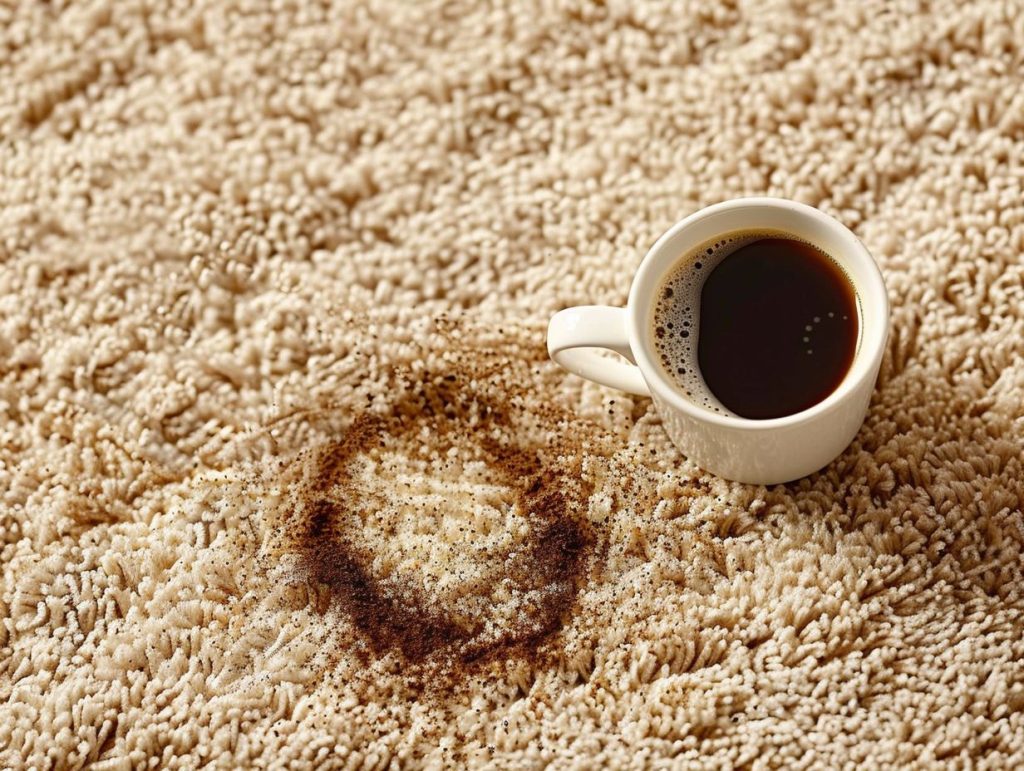
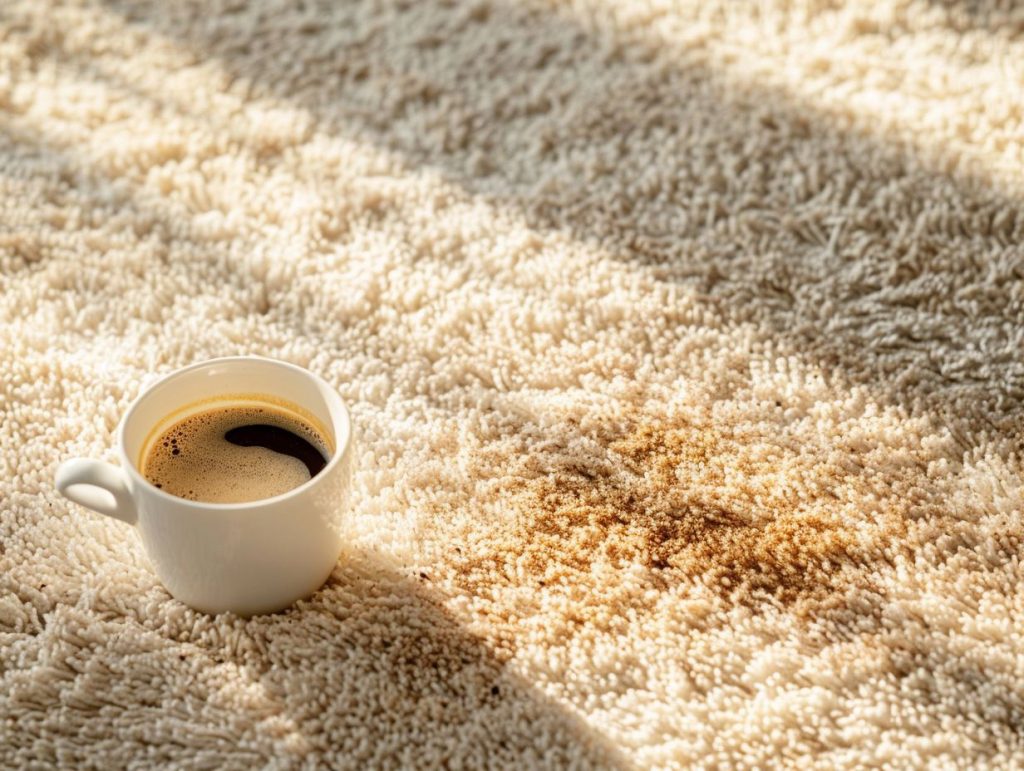
Freshly cleaned carpets sometimes develop brown patches a day or two later because of wicking, a process in which moisture rising to the surface as the carpet dries carries dissolved dirt and old spilled residue up from deep in the pile. The carpet looks spotless when the cleaner leaves, then a faint brown shadow appears as it dries, often exactly where a long-forgotten spill once soaked in. It is one of the most misunderstood things that can happen after a clean, and it is easily mistaken for poor workmanship or a stain that has somehow returned. In reality it is a predictable consequence of how liquids move through fibres, and in most cases it can be put right. The effect turns up regularly in the period homes around Hampstead, where original wool carpets and natural backings have often absorbed decades of spills. Understanding the mechanism takes the alarm out of it.

What Is Wicking and Why Does It Cause Brown Patches?

Wicking is the upward movement of moisture through carpet fibres as the carpet dries, and it causes brown patches by carrying dissolved soil from deep down up to the surface where it is left behind. The water evaporates from the tips of the pile, but the dirt it was carrying does not evaporate with it; instead it concentrates at the very top, drying into a visible mark.

The driving force is something most of us met at school. It is the same principle that lets a paper towel draw up a spill.

Capillary Action Explained

Capillary action is the tendency of liquid to travel through narrow spaces against gravity, and carpet fibres packed closely together behave like countless tiny straws. When the lower layers of a carpet are wet, moisture creeps upward through these channels toward the drier surface, and anything dissolved in that moisture travels with it. Soil, residue and the remnants of old spills that had settled near the backing are lifted to the tips of the pile and deposited there as the water leaves. Because the dirt collects at the surface rather than staying buried, a patch that looked clean can turn brown as it dries. It is movement, not new contamination, that produces the stain.

Why Do the Patches Appear Days After Cleaning, Not During?

The patches appear days after cleaning rather than during it because they form gradually as the carpet dries, and drying is a slow process that continues long after the cleaner has finished. While the carpet is still wet, the soil is suspended throughout the moisture; only as that moisture migrates and evaporates does the dirt concentrate at the surface.

This delay is exactly why wicking catches people off guard. The room looks perfect at the end of the appointment.

The Drying Timeline

A carpet can take anywhere from a few hours to a full day or more to dry completely, depending on how much water was used, the airflow in the room and the humidity of the day. Throughout that window, moisture is steadily working its way upward, so the brown mark often reaches its full strength only once the carpet is nearly dry, which may be the following morning or even a couple of days on. The slower the carpet dries, the more time moisture has to travel and the more pronounced the wicking tends to be. This is why a patch can seem to appear from nowhere well after the cleaning is done. The stain was effectively forming out of sight the entire time.

Where Does the Brown Colour Actually Come From?

The brown colour usually comes from old spills and soil that had soaked deep into the carpet or its backing, brought back to the surface by the rising moisture. Drinks, food, pet accidents and general grime can penetrate far below the visible pile over the years, settling near the backing where ordinary cleaning never reaches them.

There is also a second, related source worth knowing about, particularly in older homes. The backing material itself can be the culprit.

Hidden Spills and Natural-Fibre Browning

Many traditional carpets are made with natural jute backing, and wool fibres are themselves cellulosic in part; when these get too wet, they can release their own brownish discolouration, a phenomenon known as cellulosic browning. In the period properties of Hampstead, where original wool carpets often sit on natural backings and may have absorbed spills across many decades, both causes can occur together, which is why browning is so commonly reported on older flooring. The practical lesson is that the brown patch is rarely new dirt and almost never a fault in the carpet’s appearance before cleaning; it is material that was already present, simply hidden out of sight until moisture drew it upward. Knowing the source helps explain why the marks so often follow the lines of past accidents.

Is Wicking a Sign the Carpet Was Cleaned Badly?

Wicking is not necessarily a sign of poor cleaning, but it is closely linked to how much water was used and how quickly the carpet dried. It can happen even after careful work when a carpet holds deep, long-standing contamination, though over-wetting and slow drying make it far more likely.

The amount of moisture is the factor that matters most. The wetter the carpet gets, the further down it reaches and the more it has to wick back up.

The Role of Over-Wetting

When a carpet is over-saturated, water reaches the backing and underlay and dissolves soil that would otherwise have stayed put, then drags it all upward during a long, slow dry. A skilled clean uses controlled moisture and strong extraction to remove as much water as possible, leaving less to travel and less time for wicking to occur. That said, a carpet with decades of spills soaked into its base can wick to some degree no matter how careful the method, simply because the contamination is already there waiting to be mobilised. So while heavy over-wetting points to technique, occasional wicking on a heavily lived-in carpet is often just the nature of the material. It reflects the carpet’s history as much as the cleaning itself.

How Do You Fix Brown Patches Caused by Wicking?

Brown patches from wicking can usually be fixed by drawing the risen soil back out of the pile, ideally before it sets, with re-cleaning and proper drying. Because the dirt is now sitting at the surface, it is more accessible than it was before, which works in your favour.

A common professional remedy is straightforward in principle. The aim is to capture the soil at the tips and remove the moisture quickly.

Re-Extraction and the Towel Method

Re-cleaning the affected area with light moisture and thorough extraction lifts the concentrated soil away, and the key is then to dry the spot fast so it does not simply wick again. A simple home version is the towel-and-weight method: lay a clean, dry white towel over the damp patch and press it down with a weight, so that as the carpet dries the moisture and soil are drawn up into the towel rather than onto the pile. For persistent or natural-fibre browning, professionals use specific anti-browning treatments, often mildly acidic, that neutralise the discolouration directly. The earlier the patch is tackled the easier it lifts, so it is best not to leave it sitting for weeks. Even stubborn marks usually respond to the right approach.

How Can Wicking Be Prevented?

Wicking is best prevented by controlling moisture and drying the carpet quickly, so that soil has neither the water to travel in nor the time to rise. Since the effect depends entirely on moisture moving upward, removing that moisture promptly removes the problem at its root.

Good extraction does much of the work. The less water left in the carpet, the less can wick.

Drying and Moisture Control

Thorough extraction followed by strong airflow, from fans or open windows, speeds drying and gives moisture far less opportunity to carry soil to the surface. Low-moisture cleaning methods, which use minimal water, are particularly effective on carpets prone to browning or those with natural backings. Treating deep spills properly at the time they happen, rather than letting them soak into the backing, prevents the hidden reservoir of soil that wicking later draws up. For carpets with a known history of accidents, mentioning this to the cleaner in advance allows them to adjust their method and watch for the risk. None of these steps changes the physics of capillary action, but together they leave so little moisture and loose soil behind that wicking has little to act on. Prevention, here, is largely a matter of managing water rather than working any harder at the cleaning itself.

Frequently Asked Questions

Why is my carpet brown after cleaning when it looked fine before?

This is almost always wicking. Old spills and soil that had soaked deep into the carpet were drawn back to the surface as the carpet dried, appearing as brown patches. The marks are not new dirt but material that was already there, hidden below the pile until moisture lifted it up.

Will wicking stains go away on their own?

They generally will not disappear without intervention, since the soil has dried at the surface and needs to be removed. The good news is that wicking marks are usually easy to clean, because the dirt is now sitting at the tips of the pile rather than buried. Re-cleaning and quick drying typically lifts them.

Does wicking mean my carpet is ruined?

No. Wicking is a surface deposit of soil that had been hidden deeper down, not damage to the carpet itself, and it can almost always be treated. It looks alarming because it appears after a clean, but the carpet underneath is unchanged and usually recovers fully with the right treatment.

How long does carpet take to dry after cleaning?

Most carpets dry within a few hours to a day, though heavy cleaning, poor airflow or humid weather can extend this considerably. Faster drying matters because the longer a carpet stays wet, the more chance moisture has to wick soil to the surface. Good airflow and strong extraction shorten the time significantly.
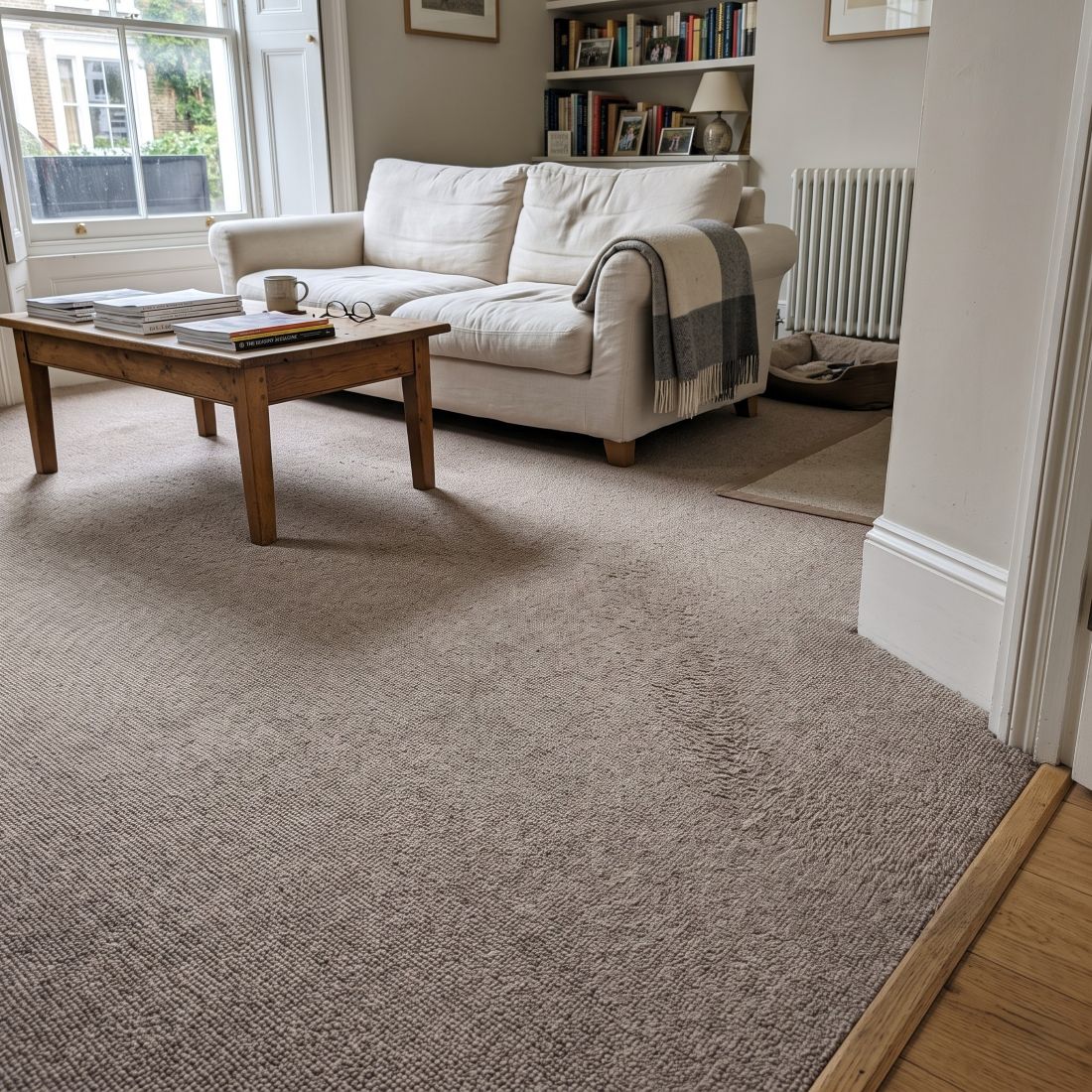
a well-maintained polypropylene carpet in a lived-in townhouse in Hampstead, London

Why a Polypropylene Carpet Can Look Worn When It’s Only Flattened

A polypropylene carpet often looks worn out long before it actually is, because the fibre flattens rather than wears away. Under steady foot traffic the upright tufts bend over and lie flat, and once they do they catch the light quite differently, taking on the dull, shadowy, slightly shiny look most people read as wear. The crucial point is that the fibres are still there and still intact; they have simply been pressed down rather than ground away. This matters because a flattened carpet is frequently recoverable, while a genuinely worn one is not, and the two are easy to confuse. It is a common source of frustration in the rental flats and busy hallways of Hampstead, where polypropylene is a popular, hard-wearing and affordable choice that nonetheless shows traffic lanes sooner than its owners expect. Knowing what is really happening underfoot changes how you respond to it.

What Is Polypropylene Carpet and Why Does It Flatten?

Polypropylene carpet flattens easily because the fibre has low resilience, meaning it does not spring back to its upright position the way more elastic fibres do. Polypropylene, also sold as olefin, is a synthetic material prized for being stain-resistant, moisture-resistant and inexpensive, which makes it a sensible choice for busy and budget-conscious homes.

Its weakness is not strength but memory. The fibre is tough, yet it lacks the natural bounce that helps a carpet stand back up after being walked on.

Resilience Versus Durability

It is worth separating two ideas that are often muddled: durability, which is how well a fibre resists damage, and resilience, which is how well it recovers its shape. Polypropylene scores reasonably on the first and poorly on the second, so it endures spills and scrubbing admirably while struggling to keep its pile upright. Wool and nylon, by contrast, have a built-in springiness that lets them rebound from compression, which is why they hold their look longer in high-traffic areas. With polypropylene, the same pressure that other fibres shrug off leaves a lasting impression in the pile. This is also why two carpets of similar age can look so different: the more resilient fibre disguises its traffic while the polypropylene displays it. Understanding this trade-off explains why a perfectly sound polypropylene carpet can start to look tired surprisingly early in its life.

What Is the Difference Between a Flattened Carpet and a Worn One?

The difference is that a flattened carpet has bent but undamaged fibres, while a worn carpet has fibres that are abraded, frayed or missing altogether. Flattening, also called crushing or matting, is a change of shape; wear is a loss of material, and only one of them can be reversed.

This distinction is the single most useful thing to understand about an ageing polypropylene carpet. One problem is cosmetic and often temporary, the other is structural and permanent.

How to Tell Which You Have

A simple check helps. Run your fingers through the pile in a dull-looking patch and look closely at the individual fibres: if they are full-length and merely lying flat, the carpet is crushed rather than worn, and grooming or professional treatment stands a good chance of lifting it. If instead you see short, broken, fuzzy fibres, thin patches where the backing shows through, or a rough texture quite unlike the surrounding carpet, that is true wear and no amount of cleaning will restore it. Crushed pile also tends to follow the obvious paths people take, whereas wear concentrates at the very points of heaviest abrasion. Diagnosing it correctly saves you from either replacing a carpet that could be revived or paying to clean one that is genuinely finished.

Why Does a Flattened Carpet Look So Much Worse Than It Is?

A flattened carpet looks worse than it is because crushed fibres reflect light in a way that reads as dirt, shading or wear even when the carpet is clean and sound. An upright pile scatters light evenly and looks rich and uniform, while a flattened pile presents the sides of the fibres to the eye, creating a shinier, darker or greyer appearance.

This is essentially an optical effect, not a measure of cleanliness. The carpet has not changed colour; only the angle of its fibres has.

The Optics of Crushed Pile

Because the bent fibres lie in roughly the same direction along a walkway, they form a continuous band that catches the light differently from the surrounding upright pile, which is why traffic lanes appear as distinct tracks across a room. People often respond by cleaning these lanes repeatedly, only to find the marks remain, because the issue was never dirt in the first place. The same effect is what makes a flattened polypropylene carpet look prematurely aged: the dull tracking suggests heavy wear when the fibres are perfectly intact underneath. Once you recognise the look as crushed pile rather than damage, the carpet stops seeming like a lost cause and starts looking like a problem with a possible solution. It also explains why the tracks can seem to come and go depending on the time of day, since changing light hits the bent fibres at different angles.

Where Does Flattening Show Up First?

Flattening shows up first in the places that take the most repeated pressure, which means the main walkways, doorways and the spots where people pause or turn. Anywhere feet pass over the same ground again and again, the pile is pushed down faster than it can recover.

The pattern is predictable once you know to look for it. Traffic concentrates along certain routes, and those routes flatten first.

The Usual High-Traffic Routes

Hallways are the classic example, along with the foot of the stairs and the desire lines that run from door to door across a living room. The narrow, much-used hallways and staircases typical of Hampstead’s period conversions tend to crush quickest of all, simply because every journey through the home funnels across the same strip of carpet. Pivot points where people turn, the area in front of a frequently used sofa, and the tracks left by rolling office chairs all flatten ahead of the rest of the room too. Spotting these zones early is useful, because flattening caught soon is generally easier to lift than crushing that has been set into the pile for years. The earlier it is addressed, the better the recovery.

Can a Flattened Polypropylene Carpet Be Revived?

A flattened polypropylene carpet can very often be revived, because the fibres are intact and simply need to be coaxed back upright. The most reliable results come from professional treatment, though some improvement is achievable at home with patience and the right tools.

Heat is the key, and here polypropylene’s nature works in your favour. The fibre is thermoplastic, which means warmth softens it enough to be reshaped.

The Role of Heat and Grooming

Hot water extraction, often called steam cleaning, combines heat, moisture and suction to relax the crushed fibres and draw them back to standing, and it is one of the most effective ways to lift flattened pile. Professionals may follow this with a pile rake or carpet groomer that lifts and separates the fibres while they are warm and pliable. At home, gentler versions of the same idea can help: carefully working the area with a stiff brush, or applying a little warmth and then grooming the pile upright, will often restore a noticeable amount of bounce. Results depend on how long the carpet has been crushed and how much heat the fibre will take without risk, which is why long-set matting is best left to someone with the proper equipment. Even partial recovery can transform how a room looks.

How Do You Stop a Polypropylene Carpet Flattening?

You slow a polypropylene carpet from flattening by spreading out the traffic it takes and grooming the pile regularly so it never stays crushed for long. The fibre’s low resilience cannot be changed, so prevention is about managing the pressure rather than expecting the carpet to recover on its own.

Reducing concentrated traffic is the first line of defence. The more the load is shared across the floor, the slower any single strip wears in.

A Simple Maintenance Routine

Runners and rugs over the busiest walkways take the brunt of the footfall, while rearranging furniture periodically shifts the traffic lanes so no single path is pounded continuously. Regular vacuuming does more than clean; by lifting and agitating the pile it helps the fibres stand back up before flattening sets, and occasional grooming with a carpet rake keeps the surface upright between deeper cleans. Moving heavy furniture a little now and then prevents permanent dents from forming under the legs. None of this defeats the fibre’s basic tendency, but together these habits keep a polypropylene carpet looking fuller and fresher for far longer than it would if left to its own devices. A modest routine goes a long way with this particular material.

Frequently Asked Questions

Does polypropylene carpet wear out quickly?

Not usually; it tends to look worn long before it actually is. Polypropylene is a durable, stain-resistant fibre, but because it has low resilience it flattens under traffic, and that flattening is frequently mistaken for wear. The carpet is often structurally fine and simply needs its pile lifted.

How do you fluff up a flattened carpet?

Warmth and grooming are the most effective combination. Applying heat and moisture, as in steam cleaning, relaxes the crushed fibres so they can be brushed or raked back upright. For small areas at home, gently working the pile with a stiff brush after warming it can bring back a good deal of its body.

Does steam cleaning fix flattened carpet?

It often does on polypropylene, because the fibre is thermoplastic and responds well to heat. Hot water extraction relaxes the bent fibres and the suction helps draw them upright again, lifting much of the flattening. Long-set matting may only partially recover and is best handled professionally.

Is polypropylene carpet good quality?

It is good value rather than premium, with real strengths and one clear weakness. It resists stains and moisture well and is affordable, which suits busy or budget-conscious homes, but its tendency to flatten means it shows traffic sooner than wool or nylon. Knowing this lets you maintain it accordingly and judge it fairly.

What “Hypoallergenic” Carpet Cleaning Actually Means

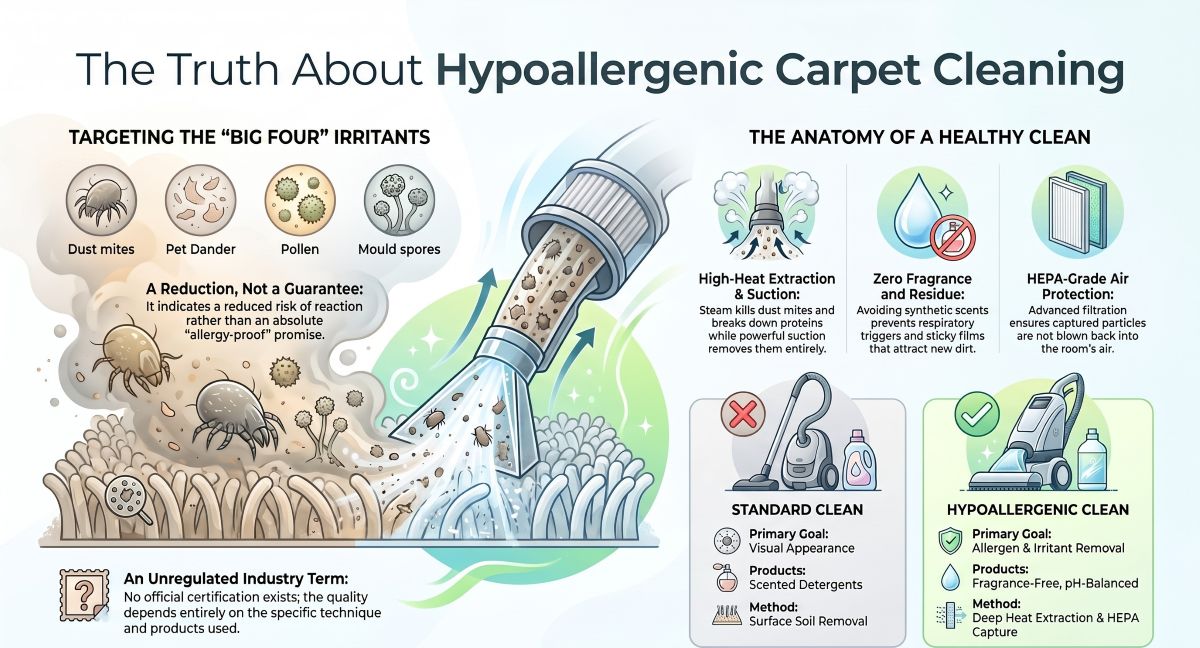
Hypoallergenic carpet cleaning means cleaning that is designed to reduce the allergens and chemical irritants in a carpet, rather than a regulated promise that the carpet will never trigger a reaction. In practice it describes a method aimed at removing the dust mites, pet dander, pollen and mould trapped in the pile while avoiding the harsh fragrances and chemical residues that can themselves set off symptoms. The word sounds reassuringly precise, yet it carries no official certification, so what actually matters is the technique and the products behind it. For the many allergy-prone households in Hampstead’s older homes, where wool carpets and period interiors hold a surprising amount of airborne debris, understanding the difference between a genuine low-allergen clean and a marketing label is worth a little time. It helps you ask the right questions and judge whether a service is actually delivering what the word implies. The term is a useful shorthand, but only once you know what it should involve.

What Does “Hypoallergenic” Actually Mean in Carpet Cleaning?

In carpet cleaning, hypoallergenic means less likely to cause an allergic reaction, not incapable of causing one. The prefix simply indicates a reduced allergen risk, and it is a relative claim rather than an absolute guarantee, which is the single most important thing to grasp before paying extra for it.

The word is loosely used across many industries, from cosmetics to bedding, and carpet care is no exception. There is no legal standard a service must meet to describe itself this way.

Why the Word Is Not a Guarantee

Because the term is unregulated, two services advertising hypoallergenic cleaning can mean quite different things by it, from a genuinely thorough allergen-removal process to little more than a fragrance-free spray. What gives the label substance is the detail underneath it: how deeply the carpet is cleaned, whether allergens are physically extracted rather than merely masked, and which products touch the fibres. A meaningful hypoallergenic clean is defined by its method and its materials, not by the marketing word itself. Treated as a question to ask rather than a promise to trust, the term becomes genuinely useful for anyone choosing a service with health in mind.

Which Allergens Build Up in a Carpet?

The main allergens that build up in a carpet are dust mites, pet dander, pollen and mould spores, all of which settle into the pile and are disturbed back into the air as people move around. A carpet effectively acts as a large filter, catching airborne particles and holding them until something releases them again.

Of these, dust mites are usually the most significant for allergy sufferers, and the most stubborn to deal with.

The Problem of Dust Mites

Dust mites are microscopic creatures that feed on the flakes of skin we all shed, and a warm, slightly humid carpet is an ideal home for them; it is their droppings and fragments, not the mites themselves, that provoke most reactions. Alongside them, pet dander clings to fibres long after an animal has left the room, pollen is tracked in from outside and settles deep in the pile, and mould can take hold wherever a carpet stays damp. The older, sometimes less ventilated houses common across Hampstead can encourage both humidity and mould, giving these allergens more chance to accumulate. Soft furnishings nearby, from curtains to upholstery, feed the same cycle by shedding their own particles onto the floor. Each is largely invisible, which is exactly why a carpet can look perfectly clean while still holding plenty of irritants. The gap between how a carpet appears and what it actually contains is the whole reason allergen-focused cleaning exists.

How Does Hypoallergenic Cleaning Remove Allergens?

Hypoallergenic cleaning removes allergens chiefly through deep extraction and heat, physically drawing the particles out of the pile rather than simply loosening them. The most effective approach is usually hot water extraction, often called steam cleaning, which combines high temperature with powerful suction to lift embedded debris away.

Heat does more than dislodge dirt. It tackles the living component of the problem directly.

The Role of Heat and Extraction

Water hot enough to clean deeply also helps break down dust mites and the proteins that cause reactions, while the extraction stage removes the loosened allergens from the home altogether rather than redistributing them. This is the key distinction between a hypoallergenic clean and a superficial one: the goal is to take the allergens out, not stir them up. Thorough drying afterwards is part of the same logic, since any moisture left behind can encourage the mould and mite growth the clean was meant to reduce. Many allergy-focused services pair extraction with HEPA-grade filtration on their equipment, so the fine particles that are pulled up are captured rather than blown back into the room. Lower-moisture methods exist too, using less water for faster drying, though they generally rely on the same principle of lifting allergens out rather than masking them. The whole process is built around capture and removal.

Why Do the Cleaning Products Themselves Matter?

The cleaning products matter because the chemicals used to clean a carpet can themselves be a source of irritation, which defeats the purpose of an allergy-focused service. A genuinely hypoallergenic clean pays as much attention to what it leaves behind as to what it takes away.

Two factors do most of the work here: fragrance and residue.

The Trouble with Fragrance and Residue

Strong synthetic fragrances and volatile compounds in some cleaning products can trigger respiratory symptoms in sensitive people, so hypoallergenic services typically favour fragrance-free or very mildly scented formulas. Equally important is residue: a detergent that is not fully rinsed leaves a sticky film in the pile that attracts dirt and can irritate skin and airways, so low-residue products and a thorough rinse stage are central to the approach. Many such cleans also use pH-balanced solutions that are gentle on both the fibre and the household, which matters especially on natural materials. It is worth remembering that a heavy artificial scent is often a sign of masking rather than cleaning, since a truly clean carpet should smell of very little at all. The principle is straightforward – a clean is only hypoallergenic if the cleaning itself does not introduce new irritants. What stays in the carpet is as important as what comes out.

Does the Type of Carpet Affect Allergen Levels?

The type of carpet does affect how many allergens it holds and how easily they are removed, with pile height and fibre both playing a part. A dense, high-pile carpet has far more surface area and far more space between fibres for particles to settle into than a low, tightly woven one.

Fibre choice shapes the picture too, and it is here that local context becomes relevant.

Wool, Synthetics and Pile Depth

The wool and wool-blend carpets that fill many of the Victorian and Edwardian homes in NW3 are natural, breathable and, contrary to a common worry, do not inherently harbour more allergens than synthetics when properly maintained; they can even help regulate humidity. What matters far more than the material is upkeep, because any carpet left uncleaned will accumulate dust mites and dander over time. Shorter, denser piles tend to be easier to clean thoroughly and release fewer trapped particles, while deep shag-style carpets demand more frequent and more careful attention. Choosing a manageable pile and keeping to a regular cleaning routine usually does more for indoor air than the fibre type alone. Rugs and runners add their own consideration, since they can be lifted and cleaned more easily than fitted carpet but also collect concentrated traffic in the spots they cover. Maintenance, not material, is the real determinant.

Can Carpet Ever Be Completely Allergen-Free?

No carpet can be made completely allergen-free, which is precisely why the honest term is hypoallergenic rather than allergen-proof. Allergens are continually reintroduced through everyday life – skin flakes, outdoor pollen, pets and open windows – so the realistic aim is sustained reduction, not permanent elimination.

This is not a failing of the method; it is simply how allergens behave.

Keeping Levels Low Between Cleans

Professional deep cleaning resets the carpet to a low-allergen baseline, but that baseline starts creeping up again the moment normal life resumes, which is why regular maintenance matters as much as any single treatment. Frequent vacuuming with a HEPA filter, prompt attention to spills and damp, and good ventilation all help keep levels down in the weeks between deeper cleans. A periodic professional clean every six to twelve months, more often in homes with pets or known allergies, keeps the cycle in check. Understood this way, hypoallergenic carpet cleaning is best seen as ongoing management of a manageable problem rather than a one-time cure. Consistency, more than any single treatment, is what keeps a carpet comfortable to live with.

Frequently Asked Questions

Is carpet bad for people with allergies?

Not necessarily. A carpet traps airborne particles and holds them out of the breathing zone, which can reduce circulating allergens compared with hard floors, but only if it is cleaned regularly. Left uncleaned, that same trapping ability lets dust mites and dander build up, so maintenance is what makes the difference.

Does hypoallergenic carpet cleaning use chemicals?

Usually yes, but carefully chosen ones. The aim is to avoid harsh fragrances, strong solvents and anything likely to leave an irritating residue, favouring low-residue, fragrance-free and pH-balanced products instead. Some services also offer largely water-and-heat-based methods for the most sensitive households.

Does steam cleaning kill dust mites?

Hot water extraction reaches temperatures high enough to break down dust mites and the proteins behind most reactions, and the suction then removes them from the carpet. It is one of the more effective methods for allergy-focused cleaning, provided the carpet is then dried thoroughly to prevent the conditions mites favour.

How often should you deep clean carpet for allergies?

For most allergy-prone homes, a professional deep clean every six to twelve months works well, with more frequent cleaning where there are pets, smokers or severe sensitivities. Regular HEPA vacuuming in between keeps allergen levels low so each deep clean has less to remove.

Why Vacuuming Direction Matters on Cut-Pile Carpets

Vacuuming direction matters on cut-pile carpets because the fibres lean a consistent way, and which way you push the machine changes how much dirt comes out, how the surface looks afterwards and how quickly the pile wears. Cut-pile carpet is built from upright tufts rather than loops, and those tufts have a natural lean – the nap – that both catches the light and traps grit at its base. In the wool and wool-blend carpets that fill so many of Hampstead’s period homes, getting the direction right is the difference between a deep, even clean and a streaky, prematurely tired surface. It sounds like a trivial detail, yet it quietly determines how good a carpet looks day to day and how many years it gives you. Understanding why the direction counts turns routine vacuuming into something that genuinely protects your floor.

What Makes Cut-Pile Carpet Directional?

Cut-pile carpet is directional because its tufts are cut at the top and lean slightly one way, creating a defined nap that behaves differently depending on which way you work across it. Unlike loop-pile, where the yarn loops back into the backing, cut-pile leaves thousands of individual fibre ends standing upright, and those ends naturally settle into a consistent lean during manufacture and use.

Run your hand across the surface and you will feel it: one direction is smooth, the other slightly resistant. That resistance is the nap, and it is the whole reason direction has any effect at all.

The Main Types of Cut-Pile

The strength of that directional effect varies by construction. Saxony, with its dense, defined tufts, shows direction and footprints readily, while plush or velvet carpet has such a smooth, level surface that it reveals the nap most dramatically of all. Textured and frieze styles, by contrast, use tightly twisted fibres that point in many directions at once, which deliberately disguises the nap and hides marks. Knowing which type sits underfoot tells you how much your vacuuming direction will show, and how carefully you need to think about it. The smoother and plusher the pile, the more direction matters.

How Does Vacuuming Against the Pile Lift More Dirt?

Vacuuming against the pile lifts more dirt because it stands the fibres upright and opens the base of each tuft, where the heaviest soiling collects. When you push the machine into the lean of the nap rather than with it, the tufts are forced to stand to attention, exposing the lower shaft and the backing that a with-the-grain pass simply glides over.

This matters because the dirt that damages carpet is not the surface fluff you can see. It is the gritty, abrasive soil that sinks to the bottom of the pile.

Where the Grit Really Hides

That base-level grit acts like sandpaper, grinding against the fibres every time someone walks across the room and cutting their lifespan with each step. Vacuuming against the nap reaches down to where this material settles and pulls it up and out, rather than skating over the top. It is also why a single quick pass rarely does much: the fibres need to be agitated and lifted for the suction to draw the embedded grit free. Going against the lean, slowly, is what gives the airflow a chance to reach the parts of the carpet that actually wear out. A surface that looks clean can still be holding the very soil that ages it fastest, which is why appearance alone is a poor guide to whether a carpet has been thoroughly cleaned. The grit you cannot see is precisely the grit that matters most.

Why Does Vacuuming Direction Change How the Carpet Looks?

Vacuuming direction changes a carpet’s appearance because the angle of the fibres controls how light reflects off the surface. When tufts lean toward you they look darker, and when they lean away they look lighter, so the same carpet can appear to be two different shades depending on which way the pile was last set.

This is the reason for the stripes and chequerboard patterns you see on a freshly vacuumed room, and it is entirely normal.

Shading, Pile Reversal and Vacuum Lines

Those light and dark bands are simply the pile lying in alternating directions, each catching the light differently, and they vanish or shift as the nap is reset. A more permanent version, known as pile reversal or shading, can develop on plush carpets where patches of pile settle the opposite way and refuse to brush back – a quirk of the fibre rather than a cleaning fault. The practical lesson is that finishing your vacuuming with consistent, parallel strokes in one direction leaves the smooth, uniform look most people want, while haphazard passes leave a patchy, unsettled surface. On a velvet or Saxony carpet in particular, the final direction you choose is what the eye sees.

Can Vacuuming the Wrong Way Damage Cut-Pile Carpet?

Vacuuming the wrong way can damage cut-pile carpet, mainly when an aggressive brush is driven hard against the nap on a delicate fibre. The direction itself is rarely the culprit; the trouble comes from combining the wrong direction with the wrong machine settings, which can fuzz, fray or flatten the pile over time.

The usual offender is the rotating brush, or beater bar, set too low for the carpet underneath it.

Getting the Beater Bar Right

A brush spinning too aggressively against a fine cut-pile can tease individual fibres loose, producing a fuzzy, worn look and shedding yarn that should still be in the carpet. On wool especially, this kind of over-agitation can cause permanent texture change. The fix is to match the machine to the floor: raise the brush height for plush and wool carpets, reduce the brush speed if your vacuum allows it, or switch the rotating brush off entirely and rely on suction for the most delicate surfaces. The goal is to lift and clean the pile, not to scour it. Used sensibly, against-the-nap vacuuming is beneficial; used with a harsh brush on a soft fibre, it shortens the carpet’s life rather than extending it.

What Is the Best Way to Vacuum a Cut-Pile Carpet?

The best way to vacuum a cut-pile carpet is to make slow passes in several directions to release embedded grit, then finish with a single set of strokes following the nap for an even appearance. Speed is the most common mistake: pushing the machine quickly gives the airflow no time to draw soil up from the base of the pile.

Begin by working across the room in one direction, then go over the same area at right angles to it.

The All-Important Finishing Pass

This cross-hatching approach, working first one way and then across it, agitates the tufts from more than one angle and lifts far more of the trapped grit than parallel passes alone. Move the machine slowly, particularly on the backward stroke, since that is when most suction actually reaches the carpet. Once the area is thoroughly cleaned, make a final set of straight, overlapping passes all in the same direction, smoothing the pile so it lies uniformly and the surface looks consistent under the light. In high-traffic spots such as hallways and the staircases common in older Hampstead homes, this slow, multi-directional method pays off most, because those are the areas where damaging grit accumulates fastest and where uneven shading shows up most plainly. A few extra minutes spent on these zones does more for a carpet’s longevity than any amount of rushed effort elsewhere.

Does the Carpet Fibre Change the Right Approach?

The carpet fibre changes the right approach because natural and synthetic materials tolerate agitation differently, and the wrong handling shows up faster on some than others. Hard-wearing synthetics such as nylon and polypropylene cope well with a brush and frequent vacuuming, whereas natural fibres demand a gentler touch.

Wool is the fibre to treat with most care, and it is also one of the most common in this part of London.

Caring for Wool and Wool Blends

The wool and wool-blend carpets found throughout the Victorian and Edwardian houses of NW3 are resilient and beautiful but prone to fuzzing if scrubbed too hard, so they reward a raised brush or suction-only cleaning and a steady, unhurried pace. Whatever the fibre, frequency matters as much as technique: regular vacuuming removes grit before it has the chance to bed down and abrade the fibres, while leaving it too long lets damaging soil accumulate at the base of the pile. Matching both your direction and your machine settings to the specific carpet underfoot is what keeps any cut-pile looking its best for the longest possible time, and the habit costs nothing once it becomes routine.

Frequently Asked Questions

Should you vacuum with or against the pile?

Both, in sequence. Vacuum against the pile and across it first to lift embedded grit from the base of the tufts, where the most damaging soil collects. Then finish with strokes that follow the pile so the surface looks smooth and even, with the fibres lying in one consistent direction.

Why does my carpet look like two different colours after vacuuming?

That is the nap catching the light, not a stain or a fault. Where the pile leans toward you it looks darker, and where it leans away it looks lighter, which produces the familiar stripes and patches on a freshly vacuumed cut-pile carpet. Brushing or vacuuming the pile in one direction evens the shade out.

How often should you vacuum a cut-pile carpet?

For most homes, two to three times a week is sensible, with high-traffic areas such as hallways and stairs vacuumed more often. Regular cleaning matters because it removes abrasive grit before it settles at the base of the pile and starts wearing the fibres down. The busier the room, the more frequently it benefits.

Does vacuuming direction remove vacuum lines?

It controls them rather than removes them, since the lines are simply pile lying in different directions. Making your final passes all in one consistent direction sets the nap uniformly and gives the smooth, line-free look most people prefer. On very plush carpets a light brush in the chosen direction can refine the finish further.

What To Do About Rust Marks Left By Furniture Legs On A Damp Carpet

Rust marks from furniture legs are a metallic stain, not ordinary dirt, and ordinary cleaning will not shift them – in fact it can make them permanent. The good news is that most of these orange-brown patches can be removed with the right acidic treatment or, where the carpet is delicate, by a professional who can control the chemistry safely. The problem turns up reliably in the period homes around Hampstead, where wool carpets, seasonal damp and metal-footed furniture make an unfortunate combination. A bed frame, a sofa castor or an iron table foot left standing on a carpet that has not fully dried after cleaning or a spill is all it takes. Knowing why the stain forms, and what not to reach for first, is the difference between a clean lift and a mark you live with for years.

Why Do Furniture Legs Leave Rust Marks on Damp Carpet?

Rust marks form when damp carpet keeps metal feet wet for long enough to corrode them. The iron in furniture feet, castors and bed frames begins to oxidise the moment it sits in prolonged contact with moisture, and the iron oxide that results bleeds into the carpet pile beneath it. Dry carpet almost never causes this; it is the lingering dampness that does the damage.

A few everyday situations bring it about. The most common is carpet that has been washed or shampooed and then had furniture replaced before it was fully dry, trapping moisture against the metal for hours or days.

The Role of Moisture in Metal Staining

Humid, poorly ventilated rooms do the same job more slowly, and so do conservatories and any spot where condensation gathers against a cold external wall. Older housing stock is especially prone to this, and the Victorian and Edwardian properties common across NW3 often combine solid walls, limited airflow and seasonal condensation in a way that keeps skirting-level carpet damp through the colder months. Add a metal furniture leg to that equation and a rust ring is almost inevitable. The mark you see is the visible end of a slow chemical reaction that has been quietly under way underneath the furniture.

How Can You Tell Rust Apart from Other Carpet Stains?

Rust marks are distinguishable by their orange-brown colour and their position exactly where metal met carpet. Before you treat anything, it is worth confirming you are actually dealing with rust, because the wrong identification leads straight to the wrong chemistry and a worse result.

The colour is the first clue. Iron oxide produces a distinctive orange to reddish-brown tone, quite unlike the duller brown of general soiling or the yellowish cast of an old watermark. The shape is the second.

The Tell-Tale Signs of Iron Oxide

A genuine rust mark mirrors the object that caused it, so you will typically see a ring, a disc or a small footprint sitting precisely beneath or around a furniture contact point rather than a random splash or a spreading patch. Location seals the diagnosis: if the stain sits directly under a bed castor, a sofa foot or a radiator bracket, rust is by far the likeliest culprit. This is what separates it from dye transfer, which tends to come from coloured fabric or paper and appears wherever that item touched, and from ordinary traffic soiling, which follows walkways rather than furniture. Getting the diagnosis right at this stage saves you from treating a metallic stain as though it were mud.

Why Does Ordinary Carpet Cleaning Make Rust Marks Worse?

Standard detergents can set a rust mark permanently rather than remove it. This is the single most important thing to understand before you touch the stain, and it is where most well-meaning attempts go wrong.

The reason is chemistry. The vast majority of household carpet shampoos and spot cleaners are alkaline, and alkaline products do not lift iron oxide – they can fix it, bonding the stain more firmly into the fibre.

The Chemistry Mistake Most People Make

Rust needs an acid to break it down, so reaching for an alkaline cleaner works directly against you. Vigorous scrubbing compounds the error by driving the oxide deeper into the pile and spreading it outward, turning a tidy ring into a diffuse smudge that is far harder to contain. Bleach and chlorine-based products deserve a particular warning: they will not remove rust, they often react with it to leave a stubborn discolouration of their own, and on wool or coloured carpet they strip dye and damage fibre permanently. The governing principle is simple and worth holding on to – rust is an acidic problem that calls for an acidic solution, and anything alkaline or abrasive is likely to make the situation worse rather than better.

How Do You Remove Rust Marks from Carpet at Home?

Most fresh rust marks lift with a mild acid such as lemon juice or white vinegar, applied and blotted carefully rather than scrubbed. The approach is gentle, patient and methodical, and it suits smaller, recent marks on hard-wearing synthetic carpet best.

Begin with a patch test in an inconspicuous spot, behind a door or under a piece of furniture, to check the carpet’s colour holds. Once you are confident, apply lemon juice or white vinegar directly to the mark and let it dwell for around five to ten minutes so the acid can work on the oxide.

Safe Acidic Treatments Step by Step

For a more stubborn mark, a paste of cream of tartar mixed with a little water gives you a slightly stronger acid that stays put on the spot. Always blot, never rub: press a clean white cloth into the stain and lift, working from the outside edge inward so you contain the mark rather than spreading it. Repeat the dwell-and-blot cycle as needed, then rinse the area thoroughly with cool water to remove every trace of acid residue, which can attract dirt or affect the pile if left behind. Finally, dry the spot completely, blotting up moisture and allowing good airflow, because any residual dampness simply invites the rust to return. Take your time over several rounds rather than forcing it in one.

When Should You Call a Professional Carpet Cleaner?

Professional help is advisable for wool carpets, large or old marks, and any carpet you genuinely cannot risk damaging. Home acids are effective on the right surfaces, but they are not universally safe, and knowing where the line sits protects your flooring.

Wool is the main reason for caution. The natural wool and wool-blend carpets found throughout the period homes and on the staircases of Hampstead are sensitive to both acid and high pH, and an over-strong lemon or vinegar treatment can damage the fibre or pull the dye, leaving a pale patch where the rust used to be.

Wool Carpets, Large Marks and Set-In Stains

Size and age matter too. A large mark, or one that has been quietly setting for months, has usually bonded deeply enough that domestic remedies barely touch it, and aggressive home attempts on a valuable or conservation-grade carpet risk turning a fixable problem into a ruined one. A professional carpet cleaner works with controlled rust removers, typically based on oxalic or citric acid, at concentrations matched to the fibre, and crucially follows the treatment with proper neutralisation and extraction so no acid is left behind. That combination of correct chemistry and full rinsing is what allows a difficult or delicate mark to be lifted without trading one form of damage for another.

How Can You Stop Rust Marks Coming Back?

Rust marks are prevented by keeping metal off damp carpet and dealing with the source of the moisture. Both halves matter, because removing a mark only to recreate the conditions that caused it is a frustrating cycle.

The first defence is a physical barrier between metal and pile. Felt or plastic furniture glides, non-metal feet and castor cups placed under beds, sofas and tables stop bare iron ever resting directly on the carpet, which removes the staining mechanism even when some damp is present.

Prevention for Period Homes and Damp Rooms

Timing helps as much as hardware. Whenever a carpet has been cleaned or has suffered a spill, lift the furniture clear or sit it on protectors and keep it raised until the carpet is completely dry, never replacing heavy metal-footed pieces onto a pile that still feels cool or damp. Beyond that, the lasting fix is to address the underlying damp itself. In the older, condensation-prone homes common across north-west London, improving ventilation, managing humidity through the colder months and resolving any localised damp at skirting level removes the moisture that lets corrosion start in the first place. Treat the conditions and you treat the cause, not just the symptom.

Frequently Asked Questions

Can rust stains be removed from carpet permanently?

In most cases, yes. Fresh marks on synthetic carpet usually respond well to a mild acid and careful blotting, while older or set-in stains often need a professional rust remover with proper neutralisation. The earlier the mark is treated, the more complete and lasting the removal tends to be.

Does WD-40 remove rust from carpet?

No, and it is best avoided. WD-40 is a petroleum-based lubricant designed to loosen rust from metal, not to lift iron oxide out of textile fibres, and using it on carpet typically leaves an oily residue that creates a second, greasy stain on top of the rust. Stick to a proper acidic treatment instead.

Will rust marks damage carpet fibres?

The rust itself is mainly a discolouration rather than a structural threat in the short term, so a promptly treated mark rarely harms the carpet. The greater risk usually comes from the treatment: harsh chemicals, bleach or heavy scrubbing can damage fibre and dye far more than the stain would have. Gentle, correct treatment protects both the look and the integrity of the pile.

How long does it take rust to stain a carpet?

It can begin within a day or two of metal sitting on genuinely damp carpet, though a faint mark may take longer to become obvious. The wetter the carpet and the longer the contact, the faster and deeper the staining. This is why furniture replaced too soon after cleaning is such a frequent cause.

Carpet Maintenance Safety Considerations: How To Avoid Irreversible Damage

The Real Risk Lurking Beneath Your Feet

Let’s be honest—most people only think about their carpets when something spills, smells, or looks so grubby it’s practically embarrassing. And when that moment comes, it’s all hands on deck. You’re dragging out the hoover, mixing up some “magic solution” you saw on TikTok, or booking a cleaner you found five minutes ago. That’s all fair enough. But here’s the catch: charging into carpet cleaning without thinking about the bigger picture can backfire. Big time.

You might fix one problem and create another. It’s surprisingly easy to damage your carpet permanently with just a bit too much heat, the wrong chemical, or a bit of overzealous scrubbing. And once that’s done—burnt fibres, faded patches, warped backing—there’s no un-doing it. We’re not trying to scare you (well, maybe just a bit), but if you want your carpets to stay clean and last, you’ve got to approach maintenance the right way.

This article isn’t just another ‘how to clean your carpet’ guide. We’re digging into the safety side of it—how to clean without wrecking the thing you’re trying to preserve. From understanding fabric types to using machines like you actually know what you’re doing, we’ll cover the key mistakes that turn a clean-up job into a costly carpet replacement.


People Often Focus on Fixing Problems – Not Preventing Damage

Panic Cleaning Is a Common Trap

Most carpet disasters begin with a reaction. Someone spills something, the dog drags mud across the lounge, or there’s a weird smell that needs sorting now. Your instinct is to grab the nearest cleaner, turn up the heat, and scrub away like you’re punishing the stain for existing. But here’s the problem—this “fix it fast” mindset skips over one huge question: Is this actually safe for my carpet?

In many cases, people do more harm than good. They mix up aggressive chemicals, ignore manufacturer guidelines, or use harsh tools that rip fibres or wear down the pile. Stains might go, but what’s left behind is often worse—bleached patches, discolouration, or brittle, broken carpet tufts.

Think Long-Term, Not Just Immediate

A bit of patience can go a long way. Before tackling a problem, take a moment to check what your carpet is made of. Is it wool? Nylon? Polyester? Each one reacts differently to heat, water, and cleaning agents. A quick lookup could save you a few hundred quid and a lot of heartache.


Using the Wrong Technique for the Wrong Fabric

One Carpet Does Not Fit All

There’s a reason professional cleaners always ask what kind of carpet you have. Wool, for instance, hates strong alkalis and high heat. Blast it with hot detergent and you could end up shrinking the fibres or ruining the texture completely. Synthetic carpets like polypropylene can take a bit more abuse, but even they have their limits—too much heat and they’ll melt.

It’s not just about what you use, but how you use it. Scrubbing a loop pile carpet, for example, can cause the loops to fray and unravel. Some fabrics soak up liquids quickly, so over-wetting them leads to long dry times, mould growth, or water damage underneath.

Always Spot Test First

This is one tip we can’t stress enough. No matter what method or product you’re using—spot test it. Pick an out-of-sight area, apply your cleaner, wait, and see how it behaves. If it changes colour, texture, or smell, that’s your warning. Better one small patch than a whole living room disaster.


Hot Water Extraction: Brilliant, but Not Always Safe

The Magic of Steam… with a Warning Label

Hot water extraction (often wrongly called steam cleaning) is one of the best ways to deep clean a carpet. It’s thorough, reaches deep into the fibres, and lifts out years of grime. But it’s not without risks.

If your carpet is older, has a delicate backing, or is glued down, pumping hot water into it might cause more harm than good. You could loosen the glue, shrink the fibres, or leave so much moisture behind that it never quite dries. Then you’re facing mould, mildew, and that musty smell that clings no matter how many candles you light.

Know When to Say No

Not all carpets are built for hot water extraction. Certain wool blends or natural fibres (like jute or sisal) can break down under that much moisture. If you’re unsure, check with the carpet manufacturer or consult a pro before steaming ahead. It’s better to do a light clean safely than risk deep cleaning something that can’t take it.


Going Too Heavy on Detergents

More Suds Doesn’t Mean More Clean

This is a classic mistake. People think if a little cleaner is good, then a lot must be brilliant. It’s not. In fact, using too much detergent can make your carpet sticky, stiff, or just plain weird underfoot. Worse still, the soap you leave behind becomes a magnet for dirt. That means your carpet will get dirty again faster, not cleaner.

Rinse, Rinse, Rinse – Then Rinse Again

If you’ve used any cleaning solution—homemade or shop-bought—make sure you rinse it out properly. If you’re using a carpet machine, run clean water over the area after the wash cycle. If you’re spot-cleaning by hand, follow up with a damp cloth to blot out as much residue as possible.

And please, resist the urge to add extra product to make it “smell nice.” That’s what candles are for. Or actual carpet deodorisers designed for the job.


Know Your Machine Before You Use It

Heavy-Duty Doesn’t Mean Foolproof

Hiring a carpet cleaner from your local supermarket might feel like a smart move. It is—if you know what you’re doing. But too often, people fire up those machines without reading the instructions. They go full power on delicate rugs, drench the carpet in water, and forget the all-important drying step. Then they’re left wondering why their floor feels crunchy or damp three days later.

Start Small and Low

Test the machine on a low setting in a small area first. Get a feel for how much water it sprays, how powerful the suction is, and how fast it works. Don’t rush. Move slowly so the machine has time to do its job—too fast and you’ll just wet the carpet without lifting any dirt.

If you’re feeling unsure, ask the hire company for a quick demo. Or better yet, book a professional and watch how they handle it. You’ll learn more in 10 minutes watching a pro than you will guessing your way through the user manual.


Wrapping Up: Clean Smart, Not Just Hard

There’s a satisfying feeling in seeing your carpet look brand new again. But don’t let that satisfaction come at the cost of irreversible damage. The smartest cleaners—professional or DIY—think before they act. They test, they read labels, and they never assume a one-size-fits-all approach.

Your carpet deserves that kind of respect. After all, it’s probably the most used surface in your home. Whether it’s bare feet, muddy paws, or the occasional wine spill—it’s always under pressure. Take care of it the right way, and it’ll look after your floors for years to come. Skip the safety steps, and you might find yourself browsing for replacements far sooner than you planned.

So next time you’re about to attack that stain with wild abandon—pause. Ask yourself: is this safe? Is this smart? Is this actually helping?

If the answer isn’t clear, walk away, grab a cuppa, and come back when you’re ready to clean without regret.

How to Eliminate Coffee Stains: Tips for a Spotless Carpet

Are you tired of battling those tough coffee stains on your carpet or clothes? We’ll walk you through some practical tips for tackling these pesky stains, from classic methods like blotting and dabbing to using everyday household items. And if those stains won’t budge, we’ll discuss when it might be time to call in the professionals.

Plus, we’ll share some creative ways to give stained items a new life and turn a coffee mishap into something visually appealing. Be sure to stick around for expert advice on preventing and removing coffee stains to keep your carpet looking pristine.

Common Methods for Removing Coffee Stains

You’ve got a few tricks for removing coffee stains from your carpet. Whether you’re into DIY solutions or prefer the convenience of commercial stain removers, there are ways to get that carpet looking spotless.

One handy DIY method involves grabbing a clean cloth and blotting the coffee stain right after it happens. The goal is to soak up as much of the spill as possible. Remember: Don’t start rubbing the stain; you’ll risk spreading it deeper into the carpet fibres.

After you’ve blotted away:

  1. Whip up a mix of water and a splash of dish soap.
  2. Use another clean cloth to dab this solution onto the stain gently.
  3. For those stubborn stains, sprinkle soda on the area, let it chill, and then vacuum it up. If you’re feeling extra fancy, make a paste with bicarbonate of soda and vinegar, smear it on the stain, wait for it to dry, and then vacuum the magic away.

If DIY isn’t your thing, don’t worry. Commercial stain removers and carpet shampoos are also great options. Just follow the instructions on the label for the best results.

The Science Behind Coffee Stains

Blotting and Dabbing Techniques

Don’t forget the importance of blotting and dabbing when dealing with coffee stains. These techniques prevent the liquid from penetrating deeper into your carpet fibres, ensuring you can remove it quickly and effectively.

Press your cloth or kitchen roll gently onto the spill to soak up as much coffee as possible before it spreads. Avoid vigorously rubbing the stain, which will make the coffee go deeper into the fabric. Use colour-safe solutions like soda or warm water for a gentle and safe cleaning method. These mild options can help break down the coffee residue without causing any harm to delicate fibres in your clothing or upholstery.

Using Household Products

Household products like vinegar, hydrogen peroxide, and washing-up liquid can be your best mates when battling those pesky coffee stains on your carpet.

Vinegar’s acidic properties can help break down those coffee pigments, while hydrogen peroxide is a powerful stain remover. Mix equal parts of water and vinegar in a spray bottle to create a vinegar solution, and dilute hydrogen peroxide with water in a 1:1 ratio. And don’t forget about washing-up liquid—it teams up with these ingredients to tackle that stain head-on, creating a stain-fighting dream team.

When you apply the solution, gently dab the stained area with a clean cloth or sponge, letting the mixture soak in before you blot it up.

Using Household Products

Professional Cleaning Options

Consider professional cleaning options if you’re dealing with stubborn coffee stains or pesky deep-set marks on your carpet. They can give your carpet the TLC to bounce back and say goodbye to any lingering odours.

Professional carpet cleaning services know just how to tackle those tough coffee stains. They use enzyme-based cleaners that are like superheroes for breaking down stains without causing any harm to your carpet’s delicate fibres. And the real magic happens when they bring out the big guns – like steam cleaning techniques. The steam gets deep into the carpet pile, pulling out dirt and grime you didn’t even know was there. Before you know it, your carpet looks like it just returned from a spa day – refreshed and revitalised.

Plus, those pros have fancy equipment that zaps stains and kicks odours to the curb, leaving your space as fresh as a daisy.

When to Seek Professional Help

You need to know when to call in the professionals for those coffee stains on your carpet, especially when dealing with stubborn marks or surface stains that require special treatment.

Professional cleaning services are necessary for delicate or colourfast fabrics that need extra care. They can handle those tough stains without causing damageOrganic and enzyme-based cleaners are a great eco-friendly option that won’t leave behind nasty residues.

These natural cleaners are gentle on your fabrics but still pack a punch when breaking down deep-set coffee stains. They’ll give your carpet a thorough clean while keeping those fibres intact.

Tips for Preventing Coffee Stains

To keep your carpet looking top-notch and avoid the hassle of dealing with coffee spills, you’ve got to be proactive and prevent those stains from occurring in the first place. Whether enjoying your morning cuppa or entertaining guests, always be aware of where you place your cup to avoid accidental spills. Coasters or trays can help create a specific area for drinks and reduce the likelihood of stains.

quality carpet protection product can provide an additional barrier against liquid accidents. If you experience a spill, use environmentally friendly cleaning solutions to deal with it promptly. Don’t hesitate to seek expert advice on prevention and treatment when dealing with persistent stains.

Regular use of carpet fresheners and deodorisers will maintain the freshness of your carpet and leave your home smelling welcoming.

Preventive Measures to Keep Your Carpet Clean

To keep your carpet looking fresh and clean, you have to be proactive about tackling those pesky stains, especially notorious troublemakers like coffee spills that can ruin the vibe.

One smart move to keep your carpet in top shape is jumping on spills immediately with club soda or seltzer water. These bubbly solutions are like magic for lifting stains before they become permanent eyesores. Using absorbent towels to blot up the spill, you can soak it all quickly and stop the liquid from spreading over your carpet.

And hey, don’t forget to use colour-safe cleaning products, take preventive action with regular vacuuming, and strategically place rugs in high-traffic spots. These steps will give your carpet extra protection against stubborn stains and keep it looking fresh for longer.

Alternative Uses for Coffee Stains

If you have pesky coffee stains on your carpets, you might be surprised to learn that they can be repurposed remarkably beyond just cleaning up spills. Instead of reaching for the usual cleaning products, why not get creative and explore unique solutions for everyday challenges?

You could turn those coffee stains into natural dyes for fabrics, giving you a sustainable and eco-friendly option for adding a pop of colour to your clothing or home decor. Coffee stains are packed with valuable nutrients that can work wonders as composting materials, enriching the soil with organic goodness.

By getting creative and thinking outside the box with coffee stains, you can reduce waste and contribute to a greener environment by making the most of their versatility in innovative ways.

Creative Ways to Repurpose Stained Items

When it comes to stained items, you should think outside the box for innovative solutions that get rid of the stains and bring fresh scents and eco-friendly practices into your daily routine. Just picture the satisfaction of giving new life to a beloved stained shirt using natural solutions to clean and refresh the fabric.

Opting for organic cleaners doesn’t just help preserve the fibres; it also shows your dedication to sustainable living. Try infusing essential oils or natural extracts into your cleaning routine to turn a tedious task into a sensory delight that freshens your space. This unique approach changes how you clean and encourages an environmentally friendly mindset that supports the planet.

How To Revive A Dirt-smothered Carpet

Have you ever wondered why your carpets attract so much dirt and grime? Explore the common causes of carpet dirt and the signs that indicate your carpet needs cleaning. Learn about different carpet cleaning methods, such as steam and dry cleaning, along with step-by-step instructions on reviving a dirt-smothered carpet. We will provide valuable tips for maintaining a clean carpet to keep your floors fresh and tidy.

Why Do Carpets Get Dirty?

Carpets accumulate dirt and grime over time due to various factors, leading to a soiled appearance and compromised cleanliness.

  1. Constant foot traffic introduces soil and debris deep into the carpet fibres.
  2. Spills from beverages or food can create stubborn stains that embed within the carpet, attracting more dirt.
  3. Pet dander and fur shed by household pets contribute to the build-up of grime.
  4. Environmental factors, such as pollen, dust, and outdoor pollutants carried inside, further add to the accumulation of dirt in carpets.

All these elements work together to create a breeding ground for bacteria and allergens, necessitating regular cleaning to maintain a healthy indoor environment.

What Are the Common Causes of Carpet Dirt?

The common causes of dirt in carpets arise from everyday activities, lack of regular cleaning, and environmental factors requiring proper maintenance and cleaning routines.

  • Foot traffic is a significant factor in dirt accumulation in carpets as people constantly walk over them, transferring impurities from outside.
  • Spills, such as food or beverages, can penetrate the carpet fibres, resulting in stubborn stains if not treated promptly.
  • Pet hair and dander build up over time, becoming embedded in the carpet and attracting more dirt and grime.
  • Dust particles settling deeply into the carpet fibres contribute to the overall soiling.
  • Inadequate cleaning practices, such as infrequent vacuuming or improper spot treatment, can worsen the problem, resulting in a dull and unhygienic carpet.

How Can You Tell if Your Carpet Needs Cleaning?

Identifying the need for carpet cleaning involves assessing visible stainsodours, and the overall cleanliness of the carpet, prompting the use of vacuumingspot treatments, and deep cleaning methods.

Visual inspection is a primary method for determining if a carpet requires cleaning. Look for apparent stains, dirt accumulation, or discolouration on the surface. Even after vacuuming, it might be time for a deep cleaning if there are lingering odours. Running your fingers through the carpet fibres can help detect hidden debris or sticky residues. Utilising spot treatments for specific stains and regular deep cleaning sessions can keep your carpet looking fresh and well-maintained.

What Are the Different Types of Carpet Cleaning Methods?

Carpet cleaning methods encompass a range of techniques such as steam cleaning, dry cleaning, shampooing, bonnet cleaning, and encapsulation cleaning, each tailored for specific maintenance and restoration needs.

  1. Steam cleaning, or hot water extraction, is a popular method that removes dirt and grime deep within the carpet fibres. It involves spraying hot water and cleaning agents onto the carpet, followed by powerful suction to extract the loosened debris.
  2. On the other hand, shampooing utilises a foamy solution scrubbed into the carpet with a rotating brush, allowing the detergent to encapsulate dirt particles for easy removal.
  3. Spot treatments target specific stains and spills, offering a quick and targeted solution for localised cleaning needs.

What Are the Steps to Revive a Dirt-smothered Carpet?

Reviving a dirt-smothered carpet involves a series of steps, including vacuumingpre-treating stains, selecting the suitable cleaning method, thorough cleaning, and proper drying to restore its clean appearance and freshness.

After vacuuming to remove surface dirt, the next step is pre-treating stains using appropriate cleaners for different carpet fibres. It helps break down tough stains and prepares the carpet for deep scrubbing. When selecting a cleaning method, consider the type of carpet material to avoid damage. Work in sections to thoroughly clean the carpet using a carpet cleaning machine or a scrub brush. Once cleaned, allow the carpet to dry completely before stepping on it to prevent potential issues.

Vacuum the Carpet

Hoovering the carpet is the initial step in the cleaning process. It removes surface dirt particles, dust, and debris to prevent dirt build-up and maintain cleanliness.

Regular hoovering enhances the appearance of your carpet and plays a crucial role in extending its lifespan. By eliminating dirt particles that settle deep within the carpet fibres, you’re preventing abrasive wear that can occur over time. Proper techniques, such as overlapping strokes and hoovering in different directions, ensure more thorough debris removal. Hoovering reduces the risk of allergens collecting in the carpet, contributing to a healthier indoor environment.

Pre-treat Stains

Pre-treating stains on the carpet involves applying targeted solutions to break down and lift stubborn stains, preparing them for further cleaning and removal during the cleaning process.

This step is crucial as it helps tackle specific stains effectively, ensuring a more thorough cleaning outcome. Different solutions for pre-treating, such as enzyme-based cleaners for organic stains like food or pet accidents, oxygen bleach for discolouration, or vinegar and water mixture for acidic stains.

When dealing with persistent stains like red wine or coffee, it’s essential to let the pre-treatment solution sit for a while to penetrate the fibres. Techniques like blotting and gentle scrubbing can help loosen the stain before proceeding with deep cleansing methods.

Choose the Right Cleaning Method

Selecting the appropriate cleaning method for the carpet depends on factors such as the carpet material, the degree of dirt accumulation, and the desired level of deep cleansing and maintenance.

For instance, certain carpet materials like wool or silk may require more gentle cleaning methods, such as shampooing, to avoid damage, while synthetic carpets could withstand more robust cleaning techniques. The level of dirt present also plays a crucial role in determining whether a regular maintenance cleaning or a deep cleansing treatment is needed. Regular vacuuming and spot cleaning can suffice for light dirt accumulation, but for heavily soiled carpets, a thorough shampooing session may be necessary to rejuvenate and restore the carpet’s appearance.

Clean and Rinse the Carpet

Cleaning and rinsing the carpet involves applying cleaning solutions, agitating the fibres, and thorough rinsing to ensure comprehensive dirt removal and effective maintenance through deep cleaning.

  1. Once the cleaning solution is applied, agitating the fibres using a brush or carpet rake is crucial. Agitating helps to loosen embedded dirt and debris, allowing the cleaning solution to penetrate deeper into the carpet. This step is especially important for high-traffic areas or heavily soiled spots.
  2. After agitating, the carpet should be thoroughly rinsed with clean water to remove any remaining cleaning solution and dirt. Proper rinsing prevents residue build-up, maintains the carpet’s appearance, and extends its lifespan. It also aids in restoring the carpet fibres to their original softness and condition.

Allow the Carpet to Dry

After cleaning, allowing the carpet to dry completely is crucial to prevent mould growth, maintain freshness, and ensure proper carpet care for an extended lifespan and clean appearance.

Proper drying post-cleaning is essential for the aesthetic appeal of your carpet and its overall health and longevity. Damp carpets can become a breeding ground for mould and mildew, leading to potential health hazards and musty odours. To expedite drying, consider increasing ventilation in the room, using fans or dehumidifiers, and avoiding foot traffic until the carpet is completely dry. By prioritising swift drying, you are rejuvenating the carpet’s fibres and contributing to its long-term maintenance and freshness.

What Are Some Tips for Maintaining a Clean Carpet?

Maintaining a clean carpet involves regular vacuuming, prompt spill clean-ups, use of doormats, and periodic professional cleanings to ensure a fresh and well-maintained carpet.

When it comes to vacuuming, it is recommended to vacuum high-traffic areas at least two to three times a week to prevent dirt and debris from settling deep into the carpet fibres. Adopting a back-and-forth overlapping motion while vacuuming can help lift more dirt.

For spill management, the key is to address spills immediately by blotting the area instead of rubbing to prevent the stain from setting. Placing doormats at entry points can significantly reduce the amount of dirt and moisture tracked onto the carpet, prolonging its lifespan.

Vacuum Regularly

Regular hoovering is essential for preserving carpet fibres, preventing dirt build-up, and maintaining a tidy appearance throughout the carpeted areas of the home.

By frequently hoovering your carpets, you ensure that dirt particles, allergens, and grime are effectively removed from the carpet’s surface, thus preventing them from embedding deep into the fibres. This consistent cleaning routine not only enhances the cleanliness of your living space but also significantly extends the lifespan of your carpets. Over time, dirt accumulation can wear down the fibres, leading to premature deterioration and a worn-out look. Therefore, regular hoovering is a simple yet powerful method to protect your carpet investment and keep your home fresh and inviting.

Clean Up Spills Immediately

Promptly cleaning up spills on the carpet minimises the risk of stains, spreading, and odour retention, preserving the carpet’s cleanliness and appearance in the affected areas.

This immediate action not only safeguards the carpet’s aesthetics but also prevents the formation of stubborn stains that can be challenging to remove later. Utilising appropriate cleaning methods, such as blotting with a clean cloth or paper towel to absorb as much of the spill as possible without rubbing, is crucial. Spot treatments tailored to the specific type of stain, whether water-based, oil-based, or protein-based, can significantly enhance the success of stain removal.

Regular maintenance and quick responses to spills are crucial to keeping your carpet fresh and looking its best.

Use Doormats

Placing doormats at entry points helps reduce the transfer of dirt particles onto carpets, enhancing cleanliness and minimising the need for frequent cleaning in high-traffic areas.

These mats act as a barrier between the outdoors and indoors, trapping dirt and debris from shoes before reaching carpeted areas. By capturing soil at the doorstep, carpets’ lifespan is prolonged, as the abrasive particles that cause wear and tear are kept at bay. Investing in quality doormats not only aids in maintaining the aesthetics of your home but also contributes to a healthier indoor environment by preventing allergens and contaminants from spreading throughout the house.

Schedule Professional Cleanings

Regular professional cleanings are essential for deep cleansing carpets, removing embedded dirt allergens, and rejuvenating the carpet fibres for a refreshed appearance and extended lifespan.

These professional cleanings are crucial in maintaining optimal carpet health and longevity. The deep cleaning process eliminates tough stains, ensuring that your carpets look as good as new. Periodic cleanings help prevent the build-up of mould and bacteria, creating a healthier indoor environment. By refurbishing the fibres, professional cleaners can revitalise your carpets’ overall look and feel, extending their lifespan and preserving their beauty for years to come.

How My 10 000-pound Persian Rug Almost Got Ruined

Disclaimer: The following story was told to one of our professional rug cleaners by a long-term customer and appears in our blog in its original text.

Purchasing A Masterpiece

When most people hear Dubai, they think of the breathtaking skyscrapers, the Burj al Arab, the magical blue sea, and the artificial islands. But those who know better would tell you the real gem of the place is the Old City with its narrow winding streets and the unmistakable atmosphere of the old Orient. In its small picturesque artisan shops, you may find wonders and hidden treasures that are unavailable in even the most prestigious and luxurious boutiques in Western Europe and the US. 

On one of my business trips to Dubai, I went on a shopping trip in the Old City. To be honest, I had received a tip from a close friend of mine who knew my weak spot for Oriental rugs. He gave me the address and directions to a small rug store and warned me not to judge by appearance. My friend had counselled me well – when I got to the place I found myself in front of a shabby looking wooden doorway, leading to a dusky pathway, flanked by sandstone walls. Little did I know that I was in for one of the biggest surprises in my life.

Once I crossed the pathway, I felt like I had walked into an imaginary world – lavish Persian, Ottoman, and Afghan rugs were hanging from the walls of a large pavilion, creating an indelible impression upon the unprepared customer. I met with the shop owner Ahmed, a 60-something short and bald-headed man with intelligent eyes and soft manners. Within five minutes, we had immersed ourselves in a conversation, ranging geographically and historically from Moorish Spain, through Persia to the Far East and handmade Chinese silk rugs.

In the interest of full disclosure, I am a devoted rug aficionado and have been for the better part of the last two decades. I started collecting high-end pieces, and my first big purchase came during a trip to Turkey in the early 2000s. But nothing at home could compare to the magnificent pieces in the Dubai shop. One rug immediately caught my eye – a large hand-woven Persian masterpiece or luxurious red wool with stylised lions chasing deers. It was a piece of simple, unadorned beauty – and I knew I had to own right away. Then came the tricky part, the stage of the purchase that every Oriental trader lives for – the bargaining. Most Westerners are utterly unprepared for it and do not understand the rules of negotiation. What they understand even less is that arguing on the price is a part of a ritual, and if you decline to take part, you are in a way offending the seller. 

Fortunately, I had grown used to the ways of the East. The more passionate the argument grows the more pleasure for your counterpart – and the closer you get to making a deal. After thirty minutes of going back and forth, we settled on ten thousand pounds, which in my opinion was a great bargain. It was also the most significant single rug purchase of my life.

The Incident

I do not believe in collecting for the sake of collecting and then storing your treasure in a hidden vault only for you to enjoy. All the rugs I’ve purchased are either in my Seven Oaks country house or in my urban flat in Kensington – or were bought as gifts. The Dubai rug (as I began to call it) was no different – it found its place in my library room in Kensington and became a favourite topic of conversation for my friends. 

A few months later, I was having a business lunch in Fitzrovia when my phone began to beep frantically. It was my housemaid, who was on her scheduled weekly cleaning visit. I had given her strict instructions not to call me during working hours, so I knew right away something serious had happened.

As it turned out, my neighbours in the flat above were doing some major renovations. The workers not only managed to bring large parts of the library ceiling paint down but must have punctured a pipe in the floor heating system, and drops of hot water were leaking on my precious rug! I did not have time hyperventilate, because I knew that time was of the essence. Fortunately, being a connoisseur of rugs means you must have a reliable rug cleaner on speed dial – which I did. Three hours later the guy knocked on the door with his heavy-duty equipment parked beside him.

“Phew, a close call!”, he said and then turned with a soothing smile on his face. Had I not noticed the problem (or my maid, but that’s not the point), the damage might have been severe, he judged. First, he carefully moved the rug away from the dropping water and took something that looked like a hair-dryer. He began to blast the pieces of paint away, drying the wool fabrics in the process. After a close and meticulous inspection, he went for a thorough deep clean with his hot water extraction machine. The pampering had an almost immediate effect – the steam removed all the dust and paint, and the rug looked fluffy and full of colours again. 

With a huge sigh of relief, I could go back to my daily business. What would have happened, though, if my maid had her appointment on another day? She had earned a nice little bonus regardless, I judged. As for my neighbours, they avoided a lawsuit for property damage, even if they had to pay for the library ceiling repainting.

Healthy And Happy Games On The Carpet – How To Ensure Perfectly Clean Home Environment To The Kids

Childhood is full of mess, rich of stains, spills and dirty traces. Mud, pet’s grime, food residues, paint experiments, crayons, spots of markers, etc. All these are a consequence of a kid’s game, which easily find their way into carpets and rugs.

How To Keep The Home Carpets Free Of Stains And Pathogens

Reviving of the textile threads is possible only through professional care. Cleaning companies are like diagnostic experts. They make a review, explore the state of the material and choose the most appropriate way of washing and further treatment.

It would be better always to remember that the condition of the floor and carpets has an enormous influence on the air quality and lifestyle of the entire home. That is extremely important when it comes to kids and babies care. Our responsibility is to ensure their happy and healthy childhood.

The carpets may appear purified because of regular cleaning and maintaining. The homemade keeping is far of the deep professional care. The grime and spots may are not visible but that is not equal to perfect cleanliness, free of bacteria and other pathogens. Professional carpet washing is the best we can do for a hygienic and healthy home environment.