
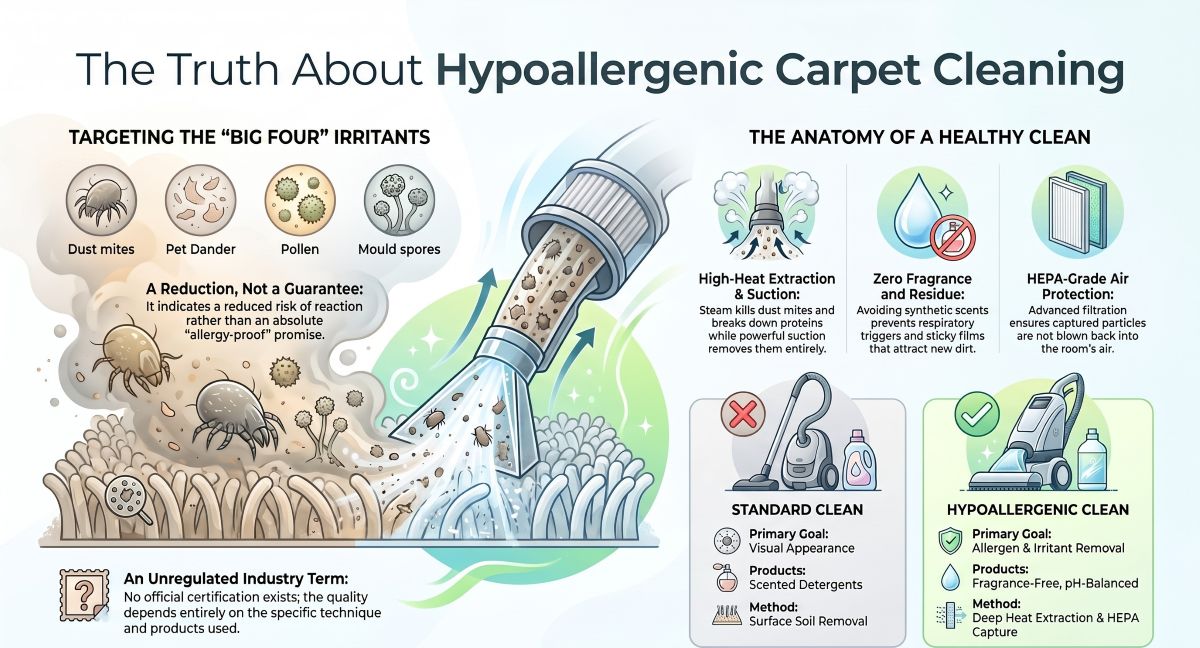
Hypoallergenic carpet cleaning means cleaning that is designed to reduce the allergens and chemical irritants in a carpet, rather than a regulated promise that the carpet will never trigger a reaction. In practice it describes a method aimed at removing the dust mites, pet dander, pollen and mould trapped in the pile while avoiding the harsh fragrances and chemical residues that can themselves set off symptoms. The word sounds reassuringly precise, yet it carries no official certification, so what actually matters is the technique and the products behind it. For the many allergy-prone households in Hampstead’s older homes, where wool carpets and period interiors hold a surprising amount of airborne debris, understanding the difference between a genuine low-allergen clean and a marketing label is worth a little time. It helps you ask the right questions and judge whether a service is actually delivering what the word implies. The term is a useful shorthand, but only once you know what it should involve.
What Does “Hypoallergenic” Actually Mean in Carpet Cleaning?
In carpet cleaning, hypoallergenic means less likely to cause an allergic reaction, not incapable of causing one. The prefix simply indicates a reduced allergen risk, and it is a relative claim rather than an absolute guarantee, which is the single most important thing to grasp before paying extra for it.
The word is loosely used across many industries, from cosmetics to bedding, and carpet care is no exception. There is no legal standard a service must meet to describe itself this way.
Why the Word Is Not a Guarantee
Because the term is unregulated, two services advertising hypoallergenic cleaning can mean quite different things by it, from a genuinely thorough allergen-removal process to little more than a fragrance-free spray. What gives the label substance is the detail underneath it: how deeply the carpet is cleaned, whether allergens are physically extracted rather than merely masked, and which products touch the fibres. A meaningful hypoallergenic clean is defined by its method and its materials, not by the marketing word itself. Treated as a question to ask rather than a promise to trust, the term becomes genuinely useful for anyone choosing a service with health in mind.
Which Allergens Build Up in a Carpet?
The main allergens that build up in a carpet are dust mites, pet dander, pollen and mould spores, all of which settle into the pile and are disturbed back into the air as people move around. A carpet effectively acts as a large filter, catching airborne particles and holding them until something releases them again.
Of these, dust mites are usually the most significant for allergy sufferers, and the most stubborn to deal with.
The Problem of Dust Mites
Dust mites are microscopic creatures that feed on the flakes of skin we all shed, and a warm, slightly humid carpet is an ideal home for them; it is their droppings and fragments, not the mites themselves, that provoke most reactions. Alongside them, pet dander clings to fibres long after an animal has left the room, pollen is tracked in from outside and settles deep in the pile, and mould can take hold wherever a carpet stays damp. The older, sometimes less ventilated houses common across Hampstead can encourage both humidity and mould, giving these allergens more chance to accumulate. Soft furnishings nearby, from curtains to upholstery, feed the same cycle by shedding their own particles onto the floor. Each is largely invisible, which is exactly why a carpet can look perfectly clean while still holding plenty of irritants. The gap between how a carpet appears and what it actually contains is the whole reason allergen-focused cleaning exists.
How Does Hypoallergenic Cleaning Remove Allergens?
Hypoallergenic cleaning removes allergens chiefly through deep extraction and heat, physically drawing the particles out of the pile rather than simply loosening them. The most effective approach is usually hot water extraction, often called steam cleaning, which combines high temperature with powerful suction to lift embedded debris away.
Heat does more than dislodge dirt. It tackles the living component of the problem directly.
The Role of Heat and Extraction
Water hot enough to clean deeply also helps break down dust mites and the proteins that cause reactions, while the extraction stage removes the loosened allergens from the home altogether rather than redistributing them. This is the key distinction between a hypoallergenic clean and a superficial one: the goal is to take the allergens out, not stir them up. Thorough drying afterwards is part of the same logic, since any moisture left behind can encourage the mould and mite growth the clean was meant to reduce. Many allergy-focused services pair extraction with HEPA-grade filtration on their equipment, so the fine particles that are pulled up are captured rather than blown back into the room. Lower-moisture methods exist too, using less water for faster drying, though they generally rely on the same principle of lifting allergens out rather than masking them. The whole process is built around capture and removal.
Why Do the Cleaning Products Themselves Matter?
The cleaning products matter because the chemicals used to clean a carpet can themselves be a source of irritation, which defeats the purpose of an allergy-focused service. A genuinely hypoallergenic clean pays as much attention to what it leaves behind as to what it takes away.
Two factors do most of the work here: fragrance and residue.
The Trouble with Fragrance and Residue
Strong synthetic fragrances and volatile compounds in some cleaning products can trigger respiratory symptoms in sensitive people, so hypoallergenic services typically favour fragrance-free or very mildly scented formulas. Equally important is residue: a detergent that is not fully rinsed leaves a sticky film in the pile that attracts dirt and can irritate skin and airways, so low-residue products and a thorough rinse stage are central to the approach. Many such cleans also use pH-balanced solutions that are gentle on both the fibre and the household, which matters especially on natural materials. It is worth remembering that a heavy artificial scent is often a sign of masking rather than cleaning, since a truly clean carpet should smell of very little at all. The principle is straightforward – a clean is only hypoallergenic if the cleaning itself does not introduce new irritants. What stays in the carpet is as important as what comes out.
Does the Type of Carpet Affect Allergen Levels?
The type of carpet does affect how many allergens it holds and how easily they are removed, with pile height and fibre both playing a part. A dense, high-pile carpet has far more surface area and far more space between fibres for particles to settle into than a low, tightly woven one.
Fibre choice shapes the picture too, and it is here that local context becomes relevant.
Wool, Synthetics and Pile Depth
The wool and wool-blend carpets that fill many of the Victorian and Edwardian homes in NW3 are natural, breathable and, contrary to a common worry, do not inherently harbour more allergens than synthetics when properly maintained; they can even help regulate humidity. What matters far more than the material is upkeep, because any carpet left uncleaned will accumulate dust mites and dander over time. Shorter, denser piles tend to be easier to clean thoroughly and release fewer trapped particles, while deep shag-style carpets demand more frequent and more careful attention. Choosing a manageable pile and keeping to a regular cleaning routine usually does more for indoor air than the fibre type alone. Rugs and runners add their own consideration, since they can be lifted and cleaned more easily than fitted carpet but also collect concentrated traffic in the spots they cover. Maintenance, not material, is the real determinant.
Can Carpet Ever Be Completely Allergen-Free?
No carpet can be made completely allergen-free, which is precisely why the honest term is hypoallergenic rather than allergen-proof. Allergens are continually reintroduced through everyday life – skin flakes, outdoor pollen, pets and open windows – so the realistic aim is sustained reduction, not permanent elimination.
This is not a failing of the method; it is simply how allergens behave.
Keeping Levels Low Between Cleans
Professional deep cleaning resets the carpet to a low-allergen baseline, but that baseline starts creeping up again the moment normal life resumes, which is why regular maintenance matters as much as any single treatment. Frequent vacuuming with a HEPA filter, prompt attention to spills and damp, and good ventilation all help keep levels down in the weeks between deeper cleans. A periodic professional clean every six to twelve months, more often in homes with pets or known allergies, keeps the cycle in check. Understood this way, hypoallergenic carpet cleaning is best seen as ongoing management of a manageable problem rather than a one-time cure. Consistency, more than any single treatment, is what keeps a carpet comfortable to live with.
Frequently Asked Questions
Is carpet bad for people with allergies?
Not necessarily. A carpet traps airborne particles and holds them out of the breathing zone, which can reduce circulating allergens compared with hard floors, but only if it is cleaned regularly. Left uncleaned, that same trapping ability lets dust mites and dander build up, so maintenance is what makes the difference.
Does hypoallergenic carpet cleaning use chemicals?
Usually yes, but carefully chosen ones. The aim is to avoid harsh fragrances, strong solvents and anything likely to leave an irritating residue, favouring low-residue, fragrance-free and pH-balanced products instead. Some services also offer largely water-and-heat-based methods for the most sensitive households.
Does steam cleaning kill dust mites?
Hot water extraction reaches temperatures high enough to break down dust mites and the proteins behind most reactions, and the suction then removes them from the carpet. It is one of the more effective methods for allergy-focused cleaning, provided the carpet is then dried thoroughly to prevent the conditions mites favour.
How often should you deep clean carpet for allergies?
For most allergy-prone homes, a professional deep clean every six to twelve months works well, with more frequent cleaning where there are pets, smokers or severe sensitivities. Regular HEPA vacuuming in between keeps allergen levels low so each deep clean has less to remove.